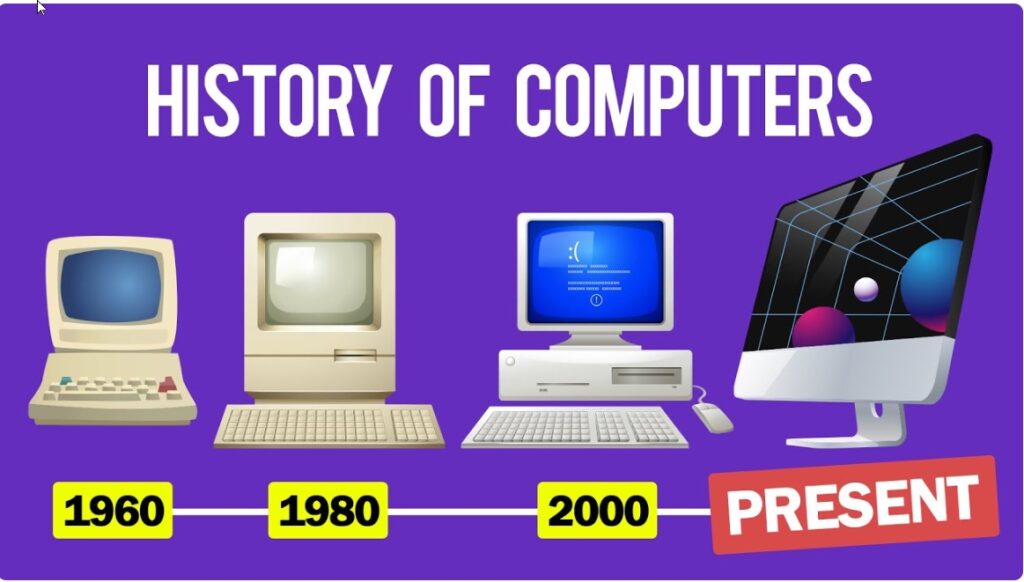
Generations of Computers
First Generation (1940–1956)
- Used vacuum tubes.
- Very large, expensive, and produced much heat.
- Example: ENIAC.
Second Generation (1956–1963)
- Vacuum tubes were replaced by transistors.
- Computers became smaller, faster, and more reliable.
Third Generation (1964–1971)
- Integrated circuits (ICs) were introduced.
- Computers became more compact and efficient.
Fourth Generation (1971–Present)
- Microprocessors were developed.
- Personal computers became common.
- Companies like Apple and Microsoft helped popularize home and office computers.
Modern Computers
Today, computers are used in education, business, medicine, communication, entertainment, and science. Modern devices such as laptops, smartphones, and tablets are powerful forms of computers connected through the internet.
Future of Computers
Future technologies may include:
- Artificial Intelligence (AI)
- Quantum Computing
- Robotics
- Advanced automation